
Kings NBA Trade Deadline (Part 2): In the Weeds On Trade Chips and Rules For Deals
Here is Part 2 of my series of posts on what the Kings need to address and think about ahead of the NBA’s February 8 trade deadline.
In this post, I take a look at what the Kings have to offer in a deal. The post focuses on what players can be traded, the trade rules and contract restrictions that might affect who will be traded, and what future draft picks the Kings can offer up.
[This is part two of a series of posts on the Kings ahead of the February 8 trade deadline. In part one, I wrote about some of the key issues that have crept up for the Kings so far this season, including issues on offense when De’Aaron Fox sits and on defense protecting the paint and three point line.]
The most exciting part about the trade deadline is imaging who your team might go get. Trade rumors, whispers about which players may want out, and hypothetical trades are all over the place this time of year, so it’s easy to get excited and jump right into playing with trade machines to build out your own hypos.
And honestly, who can blame you? Trade machines these days are pretty good! They’ll do most of the hard work for you. They have already listed out each player and their contract, identified draft assets held by each team, and figured out how to match salaries, all of which is critical to making any NBA trade work. Yet they still don’t do the harder work of figuring out how teams can protect against downside risk, address future cap issues, deal with looming contract decisions, and ensure roster flexibility. That part is still quite a slog.
Here, I’m going to go over what the Kings have to offer on the trade market, specifically current players and future draft picks, and I’ll try to flag the core, nitty-gritty issues that impact what can get done in a deal and the value of players and future picks.
So What Can the Kings Offer In a Trade?
The first thing that any team has to look at is what it has in the cupboard. Broadly speaking for basketball, there are two primary buckets: players on your roster and future draft picks.
The Players
On the player-side, the Kings have 14 players on the current roster, one player on a 10-day contract (Juan Toscano-Anderson), and three players on two-way deals so they can split time with the G-League Stockton Kings (Jordan Ford, Keon Ellis, and Jalen Slawson).
You can see a pretty comprehensive break-down of the Kings player contracts on Spotrac, but for convenience, the chart below shows the team’s player contracts (excluding 10-day contracts, two-way deals, and dead cap hits, which are pretty marginal and not worth charting for simplicity):
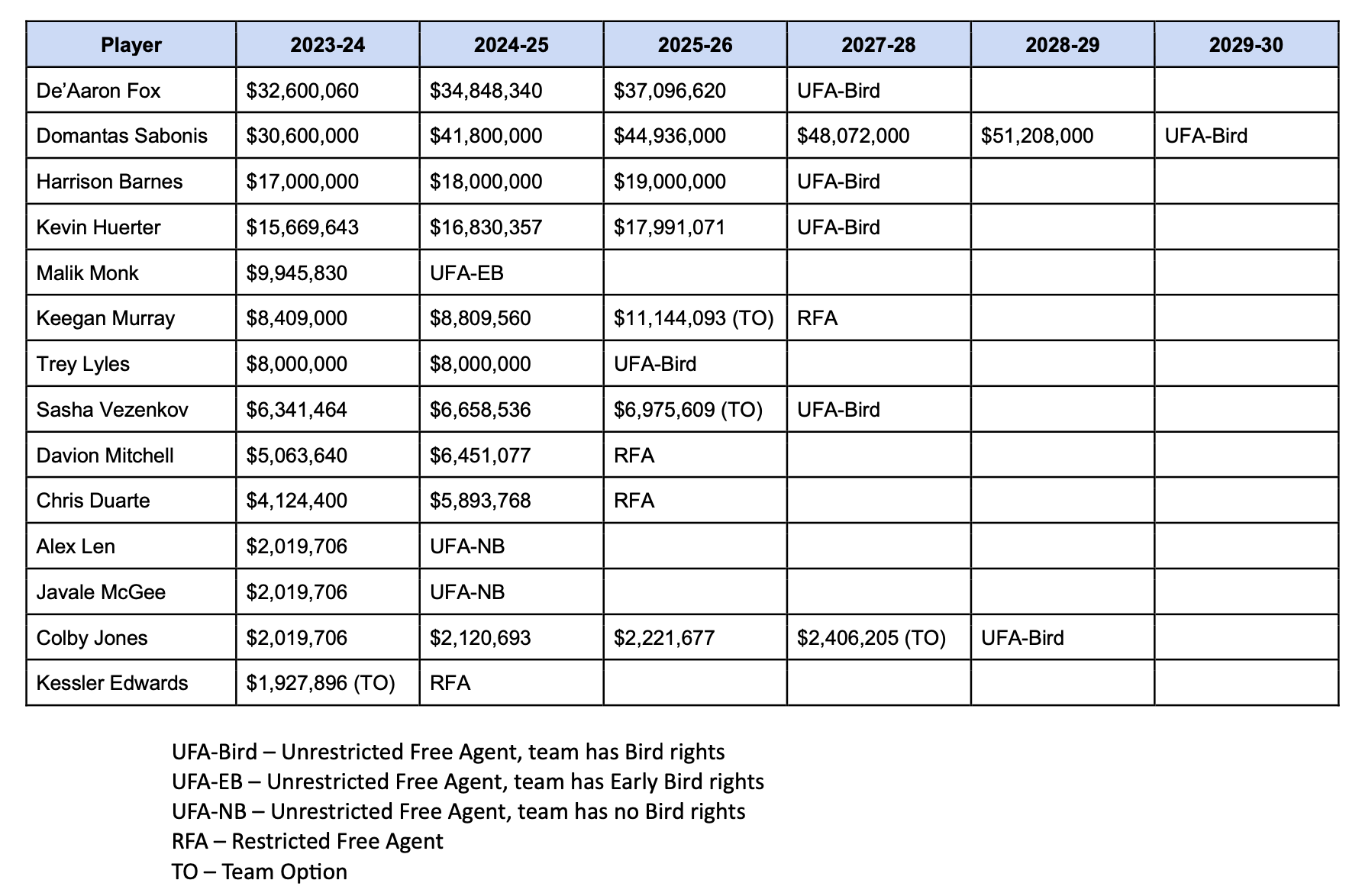
The Kings have two All-NBA caliber players under contract long-term in Fox and Sabonis, and there’s been no indication the team would even consider moving them. The team has also repeatedly shot down any notion of trading second-year player Keegan Murray, even in exchange for all-stars Pascal Siakam and Lauri Markkanen. That leaves the Kings with 12 roster players they can trade (plus one 10-day player, Juan Toscano-Anderson, and two-way players Keon Ellis, Jalen Slawson, and Jordan Ford).
Realistically, opposing teams are most likely to be interested in a handful of players—Murray (who the Kings refuse to trade), Harrison Barnes, Kevin Huerter, pending free agent Malik Monk, and Davion Mitchell—or future draft picks. The other players on the Kings roster could still be fit into a deal, either because someone wants to trade or to make salaries match, but their names don’t come up in trade rumors often because they’re not as appealing to other teams.
But we can’t just stop at listing the players the Kings might trade. We also have to look at a handful of key issues that influence who can be traded where as well as the value they have in a deal. The most important of these issues is salary matching, but I’ll also talk briefly about contract restrictions that could impact the trade value of players the Kings could consider dealing.
[The below sections on Salary Matching and Contract Restrictions are pretty granular. If you’re not interested, you can skip it, but I do want folks to understand two concepts: (1) the NBA’s CBA has detailed rules governing how trades can be constructed, which can significantly impact which players are included in trades, and (2) the CBA also has rules governing re-signing players and player extensions that can impact how much value they have in a deal.]
Salary Matching
Player-for-player trades in the NBA require "salary matching.” This can get complicated, but the basic idea is that if a team wants to trade a player, they can only receive back players with salaries inside of a certain band (or specified amount).
The amount of salary that a team can receive back in a trade depends on a few factors, the most important of which are the amount of the outgoing player’s salary and the team’s overall salary cap position. [HoopsRumors has a solid summary if you want to get into the details more, but I’ve tried to simplify things below. Relatively speaking.]
Let’s start with the team’s salary cap position to get familiar with some of the terms that will help with understanding the salary matching rules.
The NBA’s salary cap is specified each year by the league based on a pre-set formula outlined in the league’s collective bargaining agreement (CBA). For the 2023-24 season, the NBA set the salary cap at $136,021,000—teams can thus operate below the cap, at the cap, or above the cap, and different rules can apply to them as a consequence. That said, there generally aren’t many restrictions for teams simply being at or above the cap.
[In case you’re wondering, the NBA has a “soft” salary cap—meaning there are various ways to go over the cap. These exceptions cover trades, re-signing players that were already under contract with the team the previous season, signing draft picks, signing new players at the veteran’s minimum salary, and signing players using various other specified salary cap exceptions. As a result, most competitive teams end up operating above the cap in any given season.]
The NBA also has a luxury tax threshold, which is based on the cap and set at $165,294,000 for the 2023-24 season. Luxury tax teams have to pay an additional luxury tax for any salary paid at or above the luxury tax threshold. For example, if a team’s 2023-24 salary is $170,000,000, in addition to paying their salary out to the players, they have to pay an additional $4,706,000 in luxury taxes to the league, which in turn gets distributed to the other teams who aren’t luxury tax payers.
The amount of luxury tax is based on the amount by which a team exceeds the luxury tax threshold, and it gets increasingly onerous as a team spends more and more beyond the luxury tax threshold. I’ve included an explanation below, but note that all of the underlined amounts will increase in the 2025-26 seasons and beyond, per the CBA.
Between $0 and $4,999,999 above the luxury tax, teams pay $1.25 in luxury tax per dollar they go over the luxury tax threshold.
Between $5 million and $9,999,999 above the luxury tax, teams pay $1.75 in luxury tax per dollar they go over the luxury tax threshold.
Between $10 million and $14,999,999 above the luxury tax, teams pay $2.50 in luxury tax per dollar they go over the luxury tax threshold.
Between $15 million and $19,999,999 above the luxury tax, teams pay $3.25 in luxury tax per dollar they go over the luxury tax threshold.
[Teams that repeatedly have salaries above the luxury tax threshold (based on CBA-specified formulas) can also be charged additional amounts as “repeater” tax. It’s the same concept as outlined above, but the prices get even higher.]
The practical effect of the luxury tax is that as a team spends more and more above the luxury tax threshold, their roster becomes more and more expensive—and they effectively give more and more money to their competitors who stay below the luxury tax threshold.
This can have a huge effect on the trade market, because teams that can afford to spend (think big market teams like the Warriors or the Knicks) are more willing/able to pay a tax on salary, while other teams often prefer to stay below the luxury tax threshold so they can get money back.
The NBA also sets two salary cap thresholds above the luxury tax threshold called the “first apron” and the “second apron.” For 2023-24, the first apron is $172,346,000 and the second apron is $182,794,000.
Teams with salaries at or above these two thresholds are subject to a variety of restrictions this season, and will be subject to additional penalties in future years of the current CBA. We don’t need to go into the details other than to keep in mind a couple concepts:
Next year, teams are going to face increasingly stiff restrictions and/or penalties for having team salaries above the first apron and the second apron;
Specifically at issue here, teams above the first apron (and of course the second apron) have to comply with stricter trade rules; and
Teams generally don’t want to exceed the first apron or the second apron unless they need to, as they will face significantly reduced roster flexibility once the rules take effect next season.
Lastly, there is a minimum team salary threshold—often referred to as the salary floor. For the 2023-24 season, the salary floor is $122,418,000. The salary floor is an issue far less frequently than the salary cap and luxury tax threshold, and gets less attention than the first and second aprons, but the basic idea is pretty simple. Teams have to have team salaries above the salary floor, and if they don’t, they get penalized. Those penalties come in the form of having to pay up to the salary floor anyway (for example, players on the team will get paid more even though they signed contracts for less); the team will be subject to “cap holds” that prevent the team from taking advantage salary cap space below the salary floor; and the team will get 50% less money in distributions from teams paying luxury tax (this will go down to no money starting in 2025-26).
The details here aren’t so important for our purposes. What is important is to understand that there is no real benefit to teams going below the salary floor, and they can suffer penalties for doing so.
With that out of the way, let’s talk about the salary matching requirement.
The amount of salary a team can get back in a trade depends on the outgoing player salary this season and the team’s overall salary (specifically, whether the team is above the first apron). For teams below the first apron, the following salary matching rules apply:
For outgoing salaries up to $7.5 million, the team can receive back a player whose salary equals 200% of the outgoing player salary + $250k.
For outgoing salaries above $7.5 million up to $29 million, the team can receive back a player whose salary equals outgoing player salary + $7.5 million.
For outgoing salaries above $29 million, the team can receive back a player whose salary equals 125% of the outgoing player salary + $250k.
To help understand the concept, think about a few simplified examples.
A team wants to trade away a player whose salary is $5 million, which falls under Category #1 above. The player they receive back can only be paid a salary that is up to $10.25 million.
2 x $5 million + $0.25 million = $10.25 million
A team wants to trade for a player that makes $25.5 million. The player they trade away must be paid a salary of at least $18 million—this is Category #2 above.
$18 million + $7.5 million = $25.5 million
A team wants to trade away a player who makes $30 million. The most they can take back in salary is $37.75 million—see Category #3 above.
1.25 x $30 million + $0.25 million = $37.75 million
The rules are simpler, but more restrictive for teams at or above the first apron. For first apron teams, they can only take back a player whose salary is up to 110% of the outgoing salary no matter what the outgoing salary is. In practice, this means that teams at or above the first apron have less wiggle room in trades and have to match salaries more closely—they can’t take players who earn more than 10% of the players they’re sending out in a deal. This will go down to 100% starting next season.
Right now, teams generally can also aggregate salaries of multiple players in trades. Put simply, this means that teams can combine the salaries of more than one player for salary matching purposes in trades. For example, if a team wants to trade two players for three players, the salary matching rules described above still apply—the “outgoing salaries” would be the combined salaries of the two players the team is trading away, and the incoming salaries would be the combined salaries of the three players coming back in the trade.
Here’s a simplified example:
The Spurs want to trade Players A and B to the Wizards in exchange for Players X, Y, and Z. Player A has a $20 million salary and Player B has a $12 million salary.
Meanwhile, Player X has a $18 million salary, Player Y has a $8 million salary, and Player Z has a $7 million salary.
The trade is allowed, regardless of whether either team is a first apron team, because it meets all the salary matching requirements.
$20 million (Player A) + $12 million (Player B) = $32 million in outgoing salary
$18 million (Player X) + $8 million (Player Y) + $7 million (Player Z) = $33 million
General rule (non first apron teams): 1.25 x $32 million = $40 million, which is greater than the $33 million in incoming salary to the Spurs
First Apron Rule: 1.10 x $32 million = $35.2 million, which is also greater than the $33 million in incoming salary to the Spurs.
Both rules would also obviously be satisfied from the Wizards' perspective, as their $33 million of outgoing salary is greater than the returning $32 million in salary they are getting back.
Following the 2023-24 season, teams above the first apron and second apron will start to face more and more restrictions on the salary they can take back in trades and whether they can aggregate salaries for trades. Among other things, teams at or above the first apron won’t be able to take back more than the amount of salary they send out in a trade, and teams at or above the second apron won’t be able to aggregate salaries for trades (aggregation of salaries is described more below).
Teams can also send out a limited amount of cash per year in trades and/or include future draft picks in trades (which have no value for salary matching purposes).
There are a number of other minor salary matching rules that can apply in limited cases, but hopefully that covers the meat of it!
Contract Restrictions
There are a bunch of rules governing NBA contracts that are largely driven by how much time the player has served in the NBA, most of which don’t really impact trade considerations. For example, veteran players typically have fewer restrictions (although there can be exceptions and weird things like no-trade clauses exist sometimes, but they’re pretty rare).
Most of the Kings players have standard NBA deals, so there aren’t really special considerations for teams to look at when trading for them. But a few are worth flagging:
Malik Monk is scheduled to be a free agent this off-season, and either the Kings (or any team they trade Monk to) would have his “Early Bird rights.” I won’t go into detail on Bird rights, but the gist is that Bird rights let a team re-sign its own players and exceed the salary cap. “Early Bird rights” rights are a more limited version of Bird rights, but they limit how much the team can pay the player in the first year of a new contract. In Monk’s case, if he were traded, a team would be able to offer him a contract for the 2024-25 season and beyond with a starting salary at about $17.4 million and also go over the salary cap.
This could ultimately limit Monk’s trade value if teams think that Monk would be offered substantially more than $17.4 million as a free agent (which is certainly possible if not likely). This is because the team trading for Monk would be limited to offering him a below market starting salary if his contract would push the team’s salary above the cap, which in turn would make it less likely that Monk actually re-ups with them.
Separately, a number of Kings players have contracts with team options: Keegan Murray and Sasha Vezenkov in 2025-26, and Colby Jones in 2027-28. This gives teams the right to choose whether to keep the player under contract during the option year, which gives the team added control and flexibility with the player’s future contract. This is generally seen as positive for the team and bolsters trade value—especially on (comparatively) low salary deals that may prove to be below market for the player.
Keegan Murray, Davion Mitchell, Chris Duarte, and Kessler Edwards are also still on their rookie contracts, so they are slated to eventually hit "restricted free agency” rather than “unrestricted free agency” (like the rest of the Kings players) in different years. Without going into detail, unrestricted free agents can generally sign wherever they like, but the team gets the chance to match any deal a restricted free agent signs with another team—conceptually like a right of first refusal. This is generally favorable for the team, as it gives them more leverage in negotiations for players that out-perform their rookie deals in particular.
As first round picks, Murray, Mitchell, and Duarte can also be offered extensions of their contracts for up to five years (by the Kings or an acquiring team).
Draft Picks
Everyone knows that future draft picks, especially first round picks, are extremely valuable in trades. Often, teams trading away players ahead of the trade deadline are trying to turn their focus to the future, so getting back future draft picks for current players is a natural strategy.
The chart below shows the draft picks that the Kings own (in black) and the draft picks they’ve traded away (in red).
The Kings Future Picks

* Sacramento owes its 2024 first round pick to Atlanta, but it is protected for the top 14 picks. If the pick does not convey to Atlanta in 2024, it rolls over to 2025, where it is protected for the top 12 picks. If the pick does not convey to Atlanta in 2025, it rolls over to 2026, where it is protected for the top 10 picks. If the Kings pick is in the top 10 in 2026, then Atlanta loses the right to receive a first round pick and instead will receive the Kings’ second round picks in 2026 and 2027.
The CBA Restricts Trading Future Picks
As you can see from the chart above, the Kings have all of their first round picks through 2030, except for a protected pick in 2024 that they owe to the Hawks (part of the trade for Kevin Huerter almost two years ago). That’s a good war chest for trades, as they have a number of picks that they can send out in exchange for players now.
But there are a few key rules to keep in mind that restrict what the Kings can trade away.
First, per the CBA, teams can only trade draft picks up to seven years in the future, hence why the chart above only goes out to 2030. Next year, teams will be permitted to trade picks out to 2031.
Second, there’s something called the Stepien Rule, which requires that teams have a future first round pick in every other draft. In effect, this means that a team can’t trade its first round picks in successive years. Generally speaking, this is pretty simple to figure out: if a team has traded away its pick in 2024, it cannot trade its 2025 pick, the team would only be able to trade its pick in 2026 and beyond. [The Stepien Rule only applies to first round picks because the perception is that a team trading all of its first round picks could really hamstring it in the future. Second round picks aren’t seen as quite so important.]
The combination of the two rules above means that a hypothetical team today could trade, at most, four of its future first round picks: 2024, 2026, 2028, and 2030.
Third, teams can place protections on the picks they send out. Pick protections are often structured so that they pick doesn’t convey if it falls in a particular draft slot. For example, the Kings 2024 first round pick will go to the Atlanta Hawks so long as it does not fall in the top 14 picks. If the pick falls anywhere between 15 and 30, the Hawks get the pick for the 2024 draft, otherwise the Kings keep it.
Trading a future unprotected first round pick will usually net way more back in a trade than trading a top 20 protected first round pick, for example. The unprotected pick has more opportunity to convey and of course has the chance to be higher in the draft, so it carries way more value to the team trading for it. Teams often use these protections heavily as a way to change the value of their picks so that each side to a deal gets appropriate value. Pick protections can bridge the gap between a team trading for a player who is not quite worth a future first round pick, but is better than a second round pick, and the counterparty who isn’t interested in getting multiple second round picks.
Teams have a lot of flexibility to negotiate protections on picks, so long as the pick conveys within seven years at most, if at all (there are other rules, but they’re not really relevant to pick value). In other words, the protection has to be structured so that the pick either goes to the other team within seven years or the obligation to give the pick extinguishes, or alternatively turns into some other kind of trade value (like multiple second round picks that convey right away). As you can probably guess, how much protection gets placed on a particular pick has an ENORMOUS impact on that pick’s value in a trade.
All together, this can really make trading future first round picks complicated.
Let’s look at the Kings 2024 first round pick set to be traded to the Hawks. As I noted above, that pick is top 14 protected in 2024, but if it doesn’t convey to the Hawks in 2024, it gets converted to a top 12 protected pick in 2025. Same thing if it doesn’t convey in 2025, it converts to a top 10 protected pick in 2026. And, just to add some more complexity, if the pick hasn’t conveyed and Kings are picking in the top 10 in 2026, the Hawks would instead get two second round picks in 2026 and 2027. The three rules listed above conspire to really limit what the Kings can trade right now.
Because the Kings have agreed to trade their 2024 first rounder, they can’t trade their first rounder in 2025 because of the Stepien Rule. But, because the Kings placed protections on their 2024 pick, there is no guarantee that it will actually convey to the Hawks in 2024—instead, the Kings let that pick effectively roll over to 2025. Because of that, the Kings also can’t trade their first round pick in 2026, as it’s theoretically possible they would have already traded away their 2025 pick. The same situation would apply for their 2026 first round pick: because the Hawks could theoretically receive the Kings 2026 first round pick, the Kings can’t trade their 2027 first round pick under the Stepien Rule.
[1/16/24 addition: There is one caveat that I should add for completeness. The Kings can theoretically trade their 2026 first round pick if they structure the pick to be conditional on the Kings 2024 first round pick actually being conveyed to the Hawks. In such a situation, the team that trades for the Kings 2026 first round pick would only be able to get that pick if the Kings 2024 first round pick actually falls outside the top 14, and thus is conveyed to the Hawks. Otherwise, the team trading for the Kings 2026 first rounder would have to get something else (such as second round picks, a later year first round pick, etc.) or nothing.]
So What Draft Picks Can the Kings Actually Trade?
This is something that I see lots of people mix up when talking about what future the Kings have available to trade.
As of today, for their first round picks, the Kings can either trade (A) two first rounders in 2028 and 2030 or (B) one first rounder in 2029. They cannot trade their first round picks in 2025, 2026, or 2027, even though they most likely will end up owning those picks, as a result of the current deal they have with the Hawks. All of the second round picks the Kings have, however, can be traded (other than the 2030 pick they owe to Indiana).
But that’s not the end of the story!
The Kings can, in theory, remove the protections on the 2024 first round pick they owe to Atlanta to ensure that it actually conveys in 2024. Doing so would allow the Kings to open up additional first round picks for trade, such that they could make up to three first rounders available (in 2026, 2028, and 2030).
There are two things that must be accounted for, though, before the Kings remove protection from the 2024 first round pick owed to the Hawks.
The first is obvious: removing protections is the same thing as giving away value. If the Kings were to remove the protections on the pick they owe to Atlanta, it would be the same as giving additional value in the form of a better pick in 2024—so, whatever potential trade for a player this year would have to take that into account.
The second issue is that the Kings can’t unilaterally change their deal with Atlanta. Instead, the two sides have to reach another deal to change the protections. What if the Hawks think that the 2024 draft is terrible, but the 2025 draft is great? If they think that, the Hawks may not want to remove the protections on the Kings’ 2024 pick because they think it is unlikely to convey (basically meaning they think the Kings won’t make the playoffs) and they’d rather take a shot at getting a first round pick in 2025. It’s unlikely the Hawks are betting on that now, with the Kings sitting at 5th in the West, but the 2024 draft isn’t very highly rated so they may want to gamble. Regardless, the real point is that the Kings may have to give up something to take the protections off of the 2024 first rounder they owe to the Hawks so that they can be more flexible trading first round picks this year.
[1/16/24 addition: I should also flag that the Kings can trade the unprotected portions of the first round picks they’ve conveyed to the Hawks, although they won’t have as much value as a stand-alone first round pick. The Kings retain the rights over their 2024 first round pick if it lands in the top 14 (same for the top 12 picks in 2025 and top 10 picks in 2026)—essentially the inverse of what they’ve traded away from the Hawks—so they can trade those pieces. In other words, even without changing the protections on the first round picks owed to the Hawks, the Kings are allowed to trade their 2024 first round pick protected for picks 16-30, and they could add on roll-over years like they did with the Hawks deal. First round picks with these kinds of protections can be hard to value, but a Kings trade partner could essentially bet against the Kings making the playoffs in 2024 (with rollovers to 2025 and 2026, for example) by taking the lottery-protected portion of the first round pick the Kings have already traded away.
It’s also worth noting that NBA teams also can do pick swaps. This isn’t the same as trading a pick, but teams can essentially trade away the option to swap picks with another team. In such a situation, the Kings would give another team the right to choose, after the draft order is set and before the draft, between the more favorable of the Kings pick and their own. This has much less value than a pick itself, as the trade counter-party has to send back their own first round pick if they elect to swap, but these swap rights do have trade value.]
Cash
Teams can also include cash consideration in trades. Cash consideration is often used for smaller deals to make sense, as sometimes a team wants to get off of a player’s contract because they don’t play much and aren’t in the team’s future plans. Unsurprisingly, there are rules in the CBA governing how much cash can be included to avoid rich teams throwing money at less wealthy teams for their best players, but because these are usually just used for smaller deals, they don’t come up a lot. I’m talking about them here primarily to acknowledge that these rules exist and have a small part to play in deadline deals of all sizes.
For the 2023-24 seasons, teams are limited to paying cash considerations to a total of $7.05 million for the season. Theoretically, this can be split up among several trades or included in one trade. The practical effect of this limit is that cash considerations are usually only relevant for small deals involving a player or two with relatively small salaries (at least by NBA standards), otherwise it ends up not making much sense. For example, cash considerations were part of the Kings-Nets deal last year that brought in Kessler Edwards—the Nets sent Kessler Edwards and cash to the Kings so that they didn’t have to pay his salary and lower their luxury tax bill.
Part Three Coming Soon!
In the next (and probably? hopefully? last) part of this series, I’m going to look at some of the trade candidates that reporters and pundits are suggesting the Kings might pursue. I’m hoping to look at these potential trade targets from a few angles: What areas of need would they help address (PLEASE DEFENSE!)? Who would the Kings likely have to send out the door in order to get them? And, what do the Kings need to think about with respect to future draft picks and salary cap space before actually making a trade?

Kings NBA Trade Deadline (Part 1): The Kings Have to Find a Way to Get Better
This is Part 1 of a multi-part series of posts on what the Kings need to address and think about ahead of the NBA’s February 8 trade deadline.
In this post, I look at some areas the Kings might look to improve on offense and defense, including where they’ve taken a step back from last season. The Kings need to fix their offensive when De’Aaron Fox sits, find a way to shoot better from two point range, and improve their free throw shooting. Defensively, the Kings need to work on defending short shots (not at the rim) and defending the three point line. They also need to find a way to do better on the hustle stats.
Later posts will look at what trade assets the Kings have, how the salary cap will influence who they can target for trades, and whether whether any of the hot trade target names make sense.

[This is Part 1 of a multi-part series of posts on how the Kings need to look to improve ahead of the NBA’s looming trade deadline; how their assets and cap space will influence who they can target in the trade market (if anyone); and whether any of the hot trade target names make sense]
The NBA trade deadline is February 8th, a little less than one month away. Just under halfway through the season, the Kings are sitting as the fifth seed in the Western Conference at 21-14, barely ahead of the sixth-place Mavericks (22-15) and seventh-place Pelicans (22-15).
Going into back-to-back games on the road against Detroit (tonight) and Charlotte (tomorrow), by the most important measure, the Kings are already doing slightly better than last year. Last year’s team went 20-15 to start the season before ultimately winning 48 games and finishing as the 3-seed in the West.
That said, there’s no real question the Western Conference has continued to improve overall this year. The Nuggets continue to perform, Timberwolves and Thunder are gelling, the Clippers have been healthy and near-flawless after a slow start following the addition of James Harden, the Mavs and Pelicans have been effective, the Rockets finally appear to be turning things around, and the Suns are finally healthy. Only three teams in the West won 48 games or more last year, but there are seven teams in the Conference on pace to hit that mark this season (as of today). A “slight” improvement on last year may not cut it as a result.
On top of increased competition in the conference, there are some headline issues that should raise concern for the Kings and their fans.
This year’s Kings team has a negative point differential so far, scoring 0.3 points less than opponents per game. That’s 10th in the West and 18th in the NBA, and it looks more like what you would expect from a .500 team than a team with a 21-14 record.
The offense has taken a small step back, especially compared to the rest of the league. The Kings are scoring 117.7 points per game (8th in NBA), down from 120.7 last season (1st in NBA). Similarly, their offensive rating has also dropped from a league-leading 118.6 (1st overall) to 116.0 (14th overall).
The defense, which the team hoped to improve from last season, hasn’t made significant strides forward. Last year’s team had a defensive rating of 116.0 (23rd overall) and this year’s team has a defensive rating of 116.1 (21st overall).
Overall, the top-line stats above are suggestive of a team that hasn’t been able to generate enough offense to make up for its deficiencies on defense. Looking closer, though, is illuminating. The Kings have three big issues that they’re facing offensively—two of which may resolve themselves without changes to the roster. On defense, the same issues that have beleaguered them in the past are showing up, suggesting roster moves might make a difference.
Let’s jump in.
The Kings Offense Comes Back to the Pack
I am focusing on three offensive issues that have showed up consistently so far this season. These are issues that I’ve noticed watching (literally) every game so far this season, and the stats show they help explain some of the Kings’ offensive backslide, as the team has fallen from a record-setting offense to one that is just pretty good. Given the current roster, the Kings could look to improve their overall play by getting their offense back in shape without re-inventing themselves.
The Offense Craters Without Fox
The number one issue facing the Kings right now is what to do when Fox is out of the game. Every team is going to suffer when you take its best player off the court, but the Kings have tanked offensively when De’Aaron Fox is on the bench. When Fox sits, the Kings drops from 120.8 points per 100 possessions to just 111.8 based on data from PBP Stats.
Fox is also carrying the biggest offensive load of his career, which has allowed the Kings to maintain a top 10 offense overall. He’s averaging 28.3 points, 6.0 assists, and 4.4 rebounds in just over 35 minutes per game while shooting 47.0% from the field and 39.2% from three, and his usage rate is a career-high 32.4%. His numbers have dipped slightly in recent weeks in part because of the massive load he’s carrying.
While the Kings offense often runs through Sabonis at the top of the key whether Fox is in the game or not, there’s no question Fox is the driving the ship. Fox has been the team’s most prolific three point shooter this year, especially as other shooters have struggled. Keegan Murray struggled from deep early (although he’s recovering his percentages from last year). Kevin Huerter’s shooting has cratered to 34.1% from 40.2% last season, which has hurt spacing and rendered previously effective offensive plays like the Sabonis-Huerter dribble handoff ineffective. On top of his three point shooting, Fox is also the team’s most effective and frequent driver. Fox drives 16.7 times per game—the next closest on the team is Malik Monk at 11.9, per NBA.com. That penetration has opened up shots and driving lanes for the rest of the team, most of whom aren’t best hunting shots on their own.
Mike Brown has tried to mitigate the impact of sitting Fox by staggering his minutes with Sabonis—Fox typically comes out of the game with about six minutes left in the first quarter while Sabonis keeps playing, then comes back in when Sabonis rests—but that hasn’t solved the problem. Again per PBP Stats, when Fox and Sabonis share the floor, the Kings offensive rating is 120.0 and their net rating is 2.72, but even when Sabonis is in the game while Fox sits, that plummets to an offensive rating of 111.1 and a net rating of -6.54. With Fox in the game and Sabonis sitting, the Kings are still able to get by on the strength of Fox’s offense, as the team’s offensive rating jumps to 122.6 and the net rating stays at a respectable 1.59.
Having Malik Monk play with Sabonis has helped, but it’s not a cure. With Monk and Sabonis, and no Fox, the Kings have posted an offensive rating of 116.1 and a net rating of 0.74. Those line-ups rely heavily on two actions, Sabonis in the high-post (a staple for the Kings the last two years) and the Monk/Sabonis pick and roll. The Sabonis high-post game has been effective in the past, but Monk isn’t yet efficient as a pick and roll initiator despite his knack for making some electric passes. When Monk is the pick and roll ball handler, the Kings are scoring just 0.84 points per play and have a turnover frequency of 21.9% per NBA.com (the Kings don’t run pick and roll super efficiently even with Fox, but for comparison, when Fox is the pick and roll ball handler, they’re scoring 1.00 points per play with a turnover frequency of just 12.7%). Finding more efficiency out of the pick and roll when Fox is on the bench, whether from improved play by Monk (he’s still learning what passes are best as the pick and roll initiator) or through a trade addition, would go a long way in bolstering the Kings offense during the minutes he sits.
In the limited time the Kings roll with Sabonis and no Fox or Monk, the offensive is effectively non-existent. Lineups with Sabonis and no Fox or Monk are getting killed, with an offensive rating of 103.9 and a net rating of -14.9 (per PBP Stats).

Stats from PBP Stats
There isn’t a clear answer on the roster for the non-Fox minutes, either. Keon Ellis’ minutes without Fox on the floor have been productive, but they’ve been heavily influenced by low-leverage minutes. It’s tough to expect Ellis to takeover backup minutes for an All-NBA player in his first full season out of the G-League.

Stats from PBP Stats
The Kings need to find a way to prop up the offense when Fox sits. Monk has been solid, but adding another ball-handler (or pick and roll partner for Sabonis) could alleviate the pressure on Monk to create offense through pick and rolls, not his most effective tool, when things stagnate.
Trouble Shooting From Two
Even though the Kings mostly took high quality shots last year, they’ve still managed to improve their shot diet this year. Compared to last season, they’re taking more threes and fewer long-range twos. This year, the Kings are shooting threes at the third-highest rate in the NBA, 40.7 threes per 100 possessions (up from 36.9 per 100 possessions last season), and their three point shooting has held steady at around 37% (they’re shooting 37.2% this year versus 36.9% last year). A whopping 45.2% of their shots come from three point range, up an already healthy 42.3% last season. They’ve also dropped the percentage of their shots that are long twos—only 11.9% of the team’s shots are taken between 10+ feet from the basket but inside the 3 point line (compared to 13% last season).
All of that is great news! But that improved shot diet has been off-set by the team’s shooting troubles from two point range, where their shooting has dropped off meaningfully from basically everywhere.
Overall, the Kings’ two point shooting has fallen to 55.8% (9th in the NBA) from a league-leading 58.6% last year. That’s a big drop, even if it would be hard to match last year’s figure.
The drop-off has been even more noticeable (and problematic) in the paint, as those are shots that the team has hit with high frequency on the backs of Domantas Sabonis and De’Aaron Fox. The Kings are shooting a good-but-not-great 66.9% from the restricted area, good for 12th and 23rd in the NBA respectively, but down from a stellar 69.5% on 26.6 shots per game last year (per NBA.com). They’re also shooting 46.6% from the paint outside the restricted area, down from last year’s 47.7%. NBA.com also provides data by distance, which shoes that the team’s shooting from the midrange has been worse too. On shots between 10-19 feet (roughly, midrange twos), the Kings shooting has dropped to just 41.0% from 43.8% last season.
The Kings have several players shooting worse than last year from two point range. Fox and Sabonis are both down from last year, and so are Huerter and Monk. There is some hope that the two point shooting returns to last’s years form, but that is hard to bank on, as last year’s league-leading two point shooting percentage would be difficult to replicate under any circumstances without adding paint scorers or creating more space for Fox and Sabonis. Given the Kings’ issues keeping the offense afloat when Fox sits, adding a paint scorer could be the more effective answer.
Struggles With Free Throws
There’s no need to dig deeply on this one, the Kings’ free throw shooting has been plainly bad this year. They are dead last in the NBA shooting 72.9% from the line, falling from last year’s mid-pack free throw percentage of 79.0%. Fox and Sabonis dominate free throw trips for the Kings, but each is shooting worse than last year from the line. From the line, Fox is shooting 72.1% on 6.9 FT attempts per game (FTA), down from 78% on 6.0 FTAs last season; Sabonis is shooting just 65.4% on 5.4 FTAs, down from 74.2% on 5.5 FTAs last season (per Basketball Reference).
But the Kings are also drawing less fouls regardless. They were fourth-best in the league last year at drawing fouls (20.9 per game), but that’s dropped all the way to 19th (19.3 per game). This is partly the natural result of shooting more threes, but it has meant fewer trips to the foul line for easier scoring chances. With Fox’s FTAs going up and Sabonis’ FTAs staying stagnant, it’s meant that the rest of the team—generally stronger free throw shooters—have shot 3.6 less free throws per game overall compared to last year. Even if those players shot just 75% from the free throw line, that would be an additional 2.7 points per game—which has to be made up elsewhere.
Obviously the simplest way to improve at the line is for Fox and Sabonis to shoot better. Having another strong shooter who can handle the ball and draw fouls could help, but that would take the ball out of the hands of the team’s two best players. Given the team is asking its role players to shoot more threes, too, it’s hard to expect a dramatic improvement in their free throw rate, but those players have got to get to the line more nonetheless.
(Mostly) More of the Same on Defense
Top-Line Stats Say the Defense Hasn’t Changed From Last Year
The Kings have well-documented defensive issues dating back to last season (or longer depending on who you ask . . . but the team was also totally different). Last season, the Kings gave up 118.1 points per game (26th overall) with a defensive rating of 116.0 (24th overall). Despite another year under the tutelage of Head Coach Mike Brown, who is known for his defensive prowess, this year’s Kings defense is in most ways unchanged: they give up 118.0 points per game (22nd overall) with a defensive rating of 116.1 (20th overall).
A league-wide uptick in scoring does mask that the Kings have made some improvements on the defensive end. These improvements have come largely in the form of slightly more blocks, steals, and fewer offensive rebounds—but they’re small improvements at best. You can see from the chart below how some of the team’s key defensive metrics have stayed flat or regressed slightly, with the exception of opponent offensive rebounds and a slight uptick in blocks.

Stats from Basketball Reference
Still No Paint Protection
It’s never been a huge surprise that protecting the paint isn’t a strength for the Kings. Sabonis is on the smaller side of centers (perfect heights/wingspans aren’t available, but he’s listed at 6’10” with a 6’10.5” wingspan); Harrison Barnes, Keegan Murray, Trey Lyles, and Sasha Vezenkov are definitely on the small side for NBA 4’s; and Javale McGee and Alex Len don’t get enough minutes to defend the paint most of the game. Combined with perimeter players who lack ideal length—Fox, Monk, and Davion Mitchell are smaller, and Huerter, Chris Duarte, and Keon Ellis aren’t exactly pterodactyls—the Kings have to move their feet and nail rotations to defend the paint well.
There’s no denying that the Kings are once again struggling to defend the paint. Even though Sabonis in particular is a stellar big overall and has been pretty effective this year defensively (he ranks 17th overall in Basketball Reference’s Defensive Box Plus/Minus, above defensive stalwarts Rudy Gobert, Chet Holmgren, Evan Mobley, Jarrett Allen, and Walker Kessler), that hasn’t fixed the paint issues. They don’t block shots, they aren’t particularly adept at getting steals, and they don’t get a ton of deflections, as noted above.
They have improved their defense at the rim somewhat. Opponents last year shot 73.3% on shots between zero and three feet (25th in the NBA), which they’ve improved to 69.8% this year per Basketball Reference. Yet whatever improvement they’ve made at the rim has been given back to opposing offenses in the form of short jumpers and runners. On shots between 3 and 10 feet, the Kings are allowing opponents to shoot 50.3% (27th in the NBA), up from 47.5% last year.
Simply adding a big to cover the paint probably can’t solve the issue. The Kings tried this last off-season when they added Javale McGee last year in free agency, hoping to help assuage some of the rim- and paint-defense issues. McGee hasn’t been able to improve the defense overall, as the team’s defensive rating is 2.5 points worse per 100 possessions with McGee on the court versus on the bench. McGee’s length has meant that opponents shoot about 7% worse at the rim with him on the floor, but that benefit gets eaten up by the fact that opponents end up shooting 5% better from three due to McGee’s difficulties switching onto perimeter players and the Kings’ general troubles with perimeter defense.
Bigs who can protect the paint and hold their own on the perimeter are kind of like unicorns, so finding one on the trade market would be difficult, if not impossible. On the other hand, adding perimeter players who can more effectively bite down on paint shots and still defend three point shooters and dribble drives is likely an easier path to address the issue.
Still Can’t Defend the Three
The Kings are also still struggling to effectively defend the three point line. They’re once again in the bottom tier of the league, allowing opponents to shoot 38.5% from three point range, a tick worse than last year’s 37.3% mark. Watching Kings games regularly, it’s hard to avoid noticing the number of missed rotations that result in wide-open threes.
One of the biggest issues remains that they give up too many corner threes, a shot that most teams try to hunt, far too easily, even though they’ve improved slightly in that department from last season. This year, their opponents shoot 24.2% of their total threes from the corners (19th in the NBA) and they hit a robust 41.1% percent of them (20th in the NBA) per Basketball Reference. That’s in line with last year’s marks of 26.0% of threes coming from the corner (24th) and 39.5% shooting (19th).
As a team, the Kings are contesting just 15.8 threes per game, tied for 24th in the NBA. Other teams around them either do a better job of contesting shots generally, like Minnesota and Milwaukee, or play at a slower pace, like the Heat and Sixers. The Kings also don’t get their hands on many passes (13.5 deflections per game, 26th in the NBA), which would be another way to mitigate the threat of open shooters.
As with protecting the paint, adding a perimeter defender could help address these issues quite a bit.
Still Need More Hustle
When it comes to hustle plays, the Kings need to do a better job. While admittedly anecdotal, too often, games this season have slipped away because opposing teams have ramped up the intensity and the Kings haven’t. Especially when they don’t shoot well, the lack of energy and infrequency of true hustle plays has a dramatic deflating effect on the team. It’s let some opponents go on big runs and has contributed to the Kings frequently getting blown out in losses (7 of their 14 losses has been by 15 points or more). While the Kings don’t have defensive stars like some other teams, they can still do a better job with getting their hands up in passing lanes, swiping at balls without fouling, taking charges, and generally making opponents uncomfortable, especially when they’re not hitting shots, to keep opponents from going on runs.
The stats say the same thing. The Kings are 18th in offensive rebounding, tied for 18th in steals, 27th in blocks, 26th in deflections, tied for 17th in loose ball recoveries, 18th in charges drawn, 25th in shot contests, 18th in the percentage of offensive rebounds they box out on, and 13th in the percentage of defensive rebounds they box out on. These rankings aren’t all bad, and they’re certainly based on more than pure effort, but they are areas that the Kings can improve internally or by adding defense-minded players at the deadline.
Part Two Coming Soon!
In the next part of this series, I’m going to look at what the Kings have to trade and how the salary cap this season and beyond should influence their thinking ahead of the trade deadline.
Say Goodbye to Justin Fields?
(summary)
What should the Bears do with Justin Fields and the #1 overall pick in the 2024 draft? Fields’ play has been inconsistent, but there is no question he has talent. I take a dive into the key questions the Bears must consider, including Fields’ looming contract, the potential return of trading either the #1 pick or Fields himself, and the odds the Bears have to weigh that Caleb Williams or Drake Maye will be better than Fields will be going forward.
As the NFL regular season looks to wrap up this weekend, many team front offices are turning to future planning. While I’m excited to see what the playoffs have in store, with the Chargers out of playoff contention, I’ll admit that I’ve started thinking about next year too. Mostly I’ve been dreaming up ways the Bolts can fix their cap situation and knock out the upcoming 2024 draft.
But I keep thinking about a fun question: what the heck are the Chicago Bears going to do with quarterback Justin Fields?
[Obviously, this question has popped into my head totally organically . . . I’m not at all influenced by the hundreds of daily takes on Fields . . . ]
Fields’ Prospects Are Hard to Pin Down
Everybody who watches football seems to be talking about Fields and his future with the Bears. Hot takes abound on Fields future prospects, and deservedly so. He’s got a perfect resume for priming debate.
Coming into the NFL, Fields was a tantalizing prospect that inspired a lot of discussion. Fields’ pedigree was unimpeachable. A former five-star high school recruit, Fields started for two exceptional seasons at “The” Ohio State (one shortened by COVID). He went 20-2 as a starter for the Buckeyes and led them to two college football playoff appearances, throwing for over 5300 yards with 63 touchdowns and only nine interceptions. And in the first round of the 2020 college football playoff, he completely dominated a Clemson team headlined by Trevor Lawrence.
But the strong performance against Clemson was book-ended by Fields getting shut down by a good Northwestern team (weird, I know) and Ohio State getting flattened by Alabama in the National Title game, where Fields was ineffective. Those results were stunning given the Buckeyes had FOUR future NFL first round wide receivers on the roster in Chris Olave, Garrett Wilson, Jameson Williams, and Jaxson Smith-Njigba.
Folks justifiably wondered who was driving the bus for Ohio State, Fields or the receivers? Despite stellar athleticism (Fields is just under 6’3”, nearly 230 pounds, and runs a 4.46 second 40) and unquestionable arm talent, that question ultimately pushed Fields down draft boards. Although the Bears drafted him early at #11 overall, he was just the fourth quarterback selected in the 2021 draft behind Lawrence, #1 to the Jags; Zach Wilson, #2 to the Jets; and Trey Lance, #3 to the Niners—Mac Jones was drafted shortly after Fields at #15 by the Patriots.
Three years into his NFL career, it’s hard to say that Fields has settled questions about whether he can be a franchise quarterback.
The record is unquestionably poor, as the Bears have gone 10-27 with Fields as the starter. Obviously, this isn’t attributable to Fields alone, but he has struggled to find wins.
Fields’ counting stats as a passer have also been middling at best. He completes just over 60% of his passes and he averages just over 167 yards per game through the air (up to 201.2 this year, benefitting from the Bears finally adding a true WR1 in DJ Moore). He’s also thrown just 40 touchdowns in 37 starts, while throwing 30 picks, taking an astounding 130 sacks, and fumbling 38 times. The only thing keeping Fields’ traditional statistical profile palatable is his rushing, where he’s proven to be effective by rushing for 56.2 yards per game on an average of 6.3 yards per carry with 14 touchdowns. Added all up, Fields has posted paltry QBRs of 31.4, 56.3, and 46.3 in 2021, 2022, and 2023 respectively.
Qualitative metrics like PFF grades are similarly unkind to Fields as a passer. This season, amongst QBs with 100+ dropbacks, Fields’ 67.6 grade as a passer puts him as PFF’s 25th ranked passer, behind QBs like Joe Flacco, Jake Browning, Tyrod Taylor, Kenny Pickett, and Ryan Tannehill. Even accounting for Fields’ strong rushing ability, Fields still only rates as PFF’s 21st ranked QB. 2021 and 2022 weren’t better, as Fields rated 31st and and 43rd respectively amongst passers with over 100 dropbacks.
Other advanced stats for Fields paint a mixed picture. Fields sports a league-leading 3.23 seconds to throw per NFL Next Gen Stats, which jives with his penchant for for taking sacks. To be fair, Fields does try to push the ball down field, with an average depth of target of 8.8 yards per PFF, similar to players like Josh Allen, Jalen Hurts, and Trevor Lawrence—and to his credit, Fields does well on deep throws. This year, he’s averaging 12.7 yards per attempt with a 96.1 grade on throws 20+ yards down field per PFF.
Highlighting the points above is not to suggest Fields is bad at football or that he will never be successful in the NFL. Fields often mixes great plays and terrible ones, so it’s certainly possible that he can clean things up, limit the bad plays, and eventually come into his own. There’s no question he has the physical tools and pedigree to be a starter in the NFL. But at the end of the day, nobody really knows whether he will develop enough. That’s one of the biggest issues with his career in the league so far: he’s had almost 40 starts, and it’s not clear how much progress he’s made, even though it is clear his progress has been slower than the Bears had hoped.
Let’s look at the contract situation.
Regardless of whether Fields makes a leap, shows slight improvement, or takes a step backward in 2024, he’s about to get expensive. Fields is under contract next season but the Bears have to decide whether to pick up his fifth year option for 2025 this spring. If they do pick up the 5th year option, Fields will carry a cap hit of around $22 million in 2025, as projected by Over the Cap.
Assuming Fields plays well next year, to re-sign him beyond 2025, the Bears will have to open the checkbook—the Bears will probably need to pay Fields upwards of $40 million (and possibly substantially more) per year to extend him. I’m basing this off of recent QB contracts, whose value seems to rise with every passing year. In 2023, young stars Joe Burrow, Lamar Jackson, Justin Herbert, and Jalen Hurts signed deals worth over $50 million a year in average annual value (AAV). Fields doesn’t have the resume of this group, even if he has the pedigree. But keep in mind, last year also gave us contracts where Daniel Jones signed for 4 years at an AAV of $40 million per year this year and Derek Carr signed for 4 years at an AAV of $37.5 million. These contracts represent the floor of what Fields might reasonably seek in a new deal.
The salary cap for 2025 hasn’t been determined (it’s based off a percentage of league revenues), but it’s estimated to be around $260 million in 2025 and $284 million in 2026. That means that by 2026, Fields would be getting paid about 17.5% of the Bears overall cap, on par with the top QBs in the NFL (it would be 8.5% in 2025).
To justify that kind of salary outlay without hamstringing the team, Fields can’t just be a starting caliber QB, he has to be capable of carrying the team for stretches. While not a perfect comparison, consider the kinds of contract AAVs paid out to top-tier players at other key positions. The top 10 wide receiver contracts in the NFL have AAVs between $20-30 million; the top 10 left tackle AAVs range between $17-25 million; the top 10 edge rushers AAVs range between $21-34 million; and the top 10 cornerback AAVs range between $14.8-21 million. Talented players are available every year in free agency, and the Bears would be forced to forgo signing multiple top tier players at other positions in order to keep Fields—which makes sense if he’s a high-end starter, but not for midlevel quarterback play.
To their credit, the Bears do have a relatively clean cap situation in the next few years, even assuming they re-sign star corner Jaylon Johnson to a market deal this off-season. Johnson (presumably), DJ Moore, Montez Sweat, Tremaine Edmunds, Nate Davis, and Cole Kmet are the only players with cap hits over $10 million in 2024 and 2025, and the Bears could move on from several of those contracts early if needed. So they could survive over-paying Fields if he doesn’t turn into a top-flight starter—which at least gives them the option of keeping him while protecting against downside scenarios.
The Draft Picture
As a result of last year’s pre-draft trade with the Panthers, the Bears have the #1 overall pick in the 2024 draft. In any year, this would be an incredibly valuable pick, but that is especially true this year, where two quarterbacks are widely viewed as potential top-flight NFL straters. I won’t go into a detailed prospect analysis here, but Caleb Williams has been compared to the highest graded draft picks at quarterback this century (Andrew Luck and Trevor Lawrence), and even still, there are many draft prognosticators that would pick Drake Maye first. Suffice it to say, these are top-flight QB prospects.
The Bears also have their own first and third through seventh round picks plus a fourth round pick from Philadelphia, so they have a few opportunities to try to snag high-end talent in Day 1 and Day 2 of the draft while filing out the back of their roster with Day 3 picks.
There are essentially two ways to supplement their picks.
Option 1: Take a QB at #1 and Trade Fields
One option is to trade Fields, as at least nine other teams appear to have uncertainty at quarterback (the Commanders, Giants, Falcons, Vikings, Patriots, Jets, Raiders, Broncos, and Steelers). Some teams will find a future quarterback in this year’s draft—in addition to Williams and Maye, LSU’s Jayden McDaniels, Washington’s Michael Penix Jr., Michigan’s JJ McCarthy, and Oregon’s Bo Nix all project to be drafted in the first two rounds—and veteran options like Kirk Cousins, Russell Wilson, and the quarterback formerly known as Ryan Tannehill will likely become available.
Even if all eight of those players (the five rookies and three vets) start next year, that would still leave two teams without a solution at quarterback—so Fields will have a market. At just 25 years old next year, just one year older than Penix and Nix, and with multiple potential suitors, the Bears should be able to get second round pick value back for Fields—if they’re lucky, perhaps even first round value.
Option 2: Trade the #1 Overall Pick
A second option is to trade the #1 pick in this year’s draft in the hopes of building around Fields. Given the talent at the top of the draft and number of QB-needy teams, the Bears should be able to get solid return. In the last twenty years, teams have traded into the top 10 to get a quarterback just 13 times:
In 2021, the Niners traded up to pick #3 to select Trey Lance and gave up the #12 pick, a first and third round pick in 2022 (#29 and #101 overall), and a first round pick in 2023 (#29). The Bears also traded up to get Justin Fields, giving up the #20 pick, a fifth round pick (#164), and a future first and fourth round pick to move up to #11 to select Fields.
In 2018, there were three trade ups for first round QBs. The Jets traded up to pick Sam Darnold at #3 overall, giving up their first rounder (#6), two second rounders (#37 and #49), and a 2019 second rounder to do so. The Bills also traded up to pick Josh Allen, trading the #12 pick and two second rounders (#53 and #56) for the #7 pick (used to take Allen) and a 7th round pick (#255). And the Cardinals moved up to pick #10 to select Josh Rosen, trading picks #15, #79, and #152 in exchange.
In 2017, the Bears traded up to #2 to pick Mitch Trubisky and gave up the #3 pick, third (#67) and fourth round (#111), and a 2018 third rounder, but the unquestionably better deal was for the Chiefs to trade up to #10 to select Patrick Mahomes in exchange for #27, #91, and a 2018 first rounder.
In 2016, the Rams traded #15, two seconds (#43 and #45), a third (#76), and 2017 first and third round picks to move up to #1 for Jared Goff (the Rams also got a fourth and sixth round pick in the deal). The Eagles also moved up to select Carson Wentz, receiving the #2 overall pick and a 2017 fourth rounder in exchange for the #8, #77, and #100 picks, plus a 2017 first rounder and a 2018 second rounder.
In 2012, the then Redskins traded their first and second round picks (#6 and #39) plus 2013 and 2014 first round picks to the Rams for #2 overall to select Robert Griffin III.
In 2011, the Jaguars traded #16 and #49 to move up to #10 to select Blaine Gabbert.
In 2009, the Jets traded their #17 and #52 picks and three players to move up to #5 to select Mark Sanchez.
In 2004, the Giants and Chargers made a trade of quarterbacks selected in the draft that year. The Chargers sent Eli Manning (picked #1 overall by the Chargers) to the Giants in exchange for Phillip Rivers (picked #4 overall by the Giants), a third round pick (#65), and first and fifth round picks in 2005.
These trades seem to rarely work out for the team trading up, and the return for moving up to draft QBs seems to have diminished some in recent years (although most years have not had quarterbacks as highly anticipated as Caleb Williams and Drake Maye). Regardless, the Bears can fairly expect to get back at least two (possibly 3) first round picks and additional Day 2 draft capital in exchange for moving back in the 2024 draft, depending on how far back they want to go.
Option #3: Keep the #1 Pick and Take the Best Non-QB
This option is pretty crazy, so I’m not going to spend much time on it. Lots of Bears fans seem to want to keep Fields and select Marvin Harrison Jr. at #1 overall. That’s CRAZY. At the very least, you need to trade the pick to get draft capital back from Washington or New England, picking at #2 and #3 respectively, or even the Giants at #5 or Falcons at #9. There are also really high-end receivers other than Harrison Jr. at the top end of this draft—notably LSU’s Malik Nabers and Washington’s Rome Odunze. Even if the Bears had to trade down to trade back up to pick one of the top WRs (a form of Option #2). The Bears also have some need at tackle, which is in the same boat with multiple high-end prospects likely to go in the first half of the first round.
So what should the Bears do?
Despite the hand-wringing, I don’t actually think this decision is all that hard.
The Bears should move on from Fields and draft a QB at #1 this year.
Top-flight QBs Show Themselves Early, Fields Hasn’t
Regardless of whether the Bears see the glass as half full or half empty with respect to Justin Fields’ development, the hard truth is that he still has to develop substantially to get to even league-average play for a quarterback as a passer. Fields’ potential is obvious, and I have no reason to doubt that he will continue to work on his craft, as any franchise player should. At the same time, there are almost no examples of quarterbacks “figuring it out” after three years as a starter, which Fields has already had.
There have been 69 quarterbacks taken in the first round since 2000. Of those QBs, 30 (43.5%) have made at least one Pro Bowl, an admittedly flawed way to look at whether QBs were good over the years, without relying too heavily on counting stats that vary by era. Only 18 (26.1%) have made multiple Pro Bowls (five of the 30 QBs with one appearance are in their fourth year or younger, so they haven’t had many chances).
Moreover, of the 30 QBs who made a Pro Bowl, almost all of them did so within their first three years as an NFL starter—24 of 30, or 80%. Most of the exceptions performed well early too: three made their first Pro Bowl in their fourth season (Eli Manning, Ben Roethlisberger, and Tua Tagovailoa), which Fields could do but likely will not. The other exceptions are Matt Stafford—who barely missed a Pro Bowl in his third season despite throwing for over 5000 yards and 41 touchdowns in an obvious franchise QB year—and Alex Smith and Ryan Tannehill. While Smith and Tannehill became effective players, neither had the type of career that the Bears could reasonably hope for from Caleb Williams or Drake Maye, or even what they might aspire to for Fields.
In other words, we generally know early whether a first round QB is going to be good or not. After year three, no one really disputes that Fields’ trajectory is still unknown.
Top 5 Picks Like Williams and Maye Hit More Often
Conversely, the likelihood that Caleb Williams and Drake Maye go on to make a Pro Bowl (or multiple Pro Bowls) is higher based on their expected pedigree. Setting aside that Williams in particular is seen as a transcendent draft prospect, QBs picked in the top 5 are much more likely to be Pro Bowl caliber players than first round QBs in general. Again since 2000, 33 quarterbacks have been taken with a top 5 pick—19 (57.6%) have made at least one Pro Bowl and 12 (36.4%) have made two or more (five of these 33 QBs are still in their fourth year or younger). The 36 QBs picked outside the top 5 (like Fields) have made a Pro Bowl at just 30.6% clip and multiple Pro Bowls at just a 16.7% rate.
Even if the Bears like Fields, there’s a good reason to expect that Williams or Maye will outperform him. The Bears front office and GM Ryan Poles already appear to have passed on one (maybe more) franchise quarterbacks in the 2022 by trading the #1 overall pick last year. If Fields doesn’t hit, passing on another potential franchise quarterback in 2023 is the kind of thing that gets GMs fired quickly.
Resetting the QB Contract Clock Is Hugely Valuable
As discussed above, even if Fields continues to make marginal progress, he is likely to be paid upwards of $40 million per season in just three years (2026). While they won’t be locked in, effectively the Bears will have to make a costly decision on Fields this Spring to secure the fifth year option and decide whether to re-sign him long term after the 2024 season. That isn’t a lot of time to decide whether Fields is in fact the guy long-term. If they keep Fields, the Bears will be forced to make a decision soon on whether to tether themselves financially to him long-term.
Drafting a quarterback puts off that timeline for an additional three years, as Williams or Maye would be under team control—and at relatively low dollars—until 2029. Franchise QBs on rookie deals, with up to five years of team cost control, is the holy grail of roster construction. Landing one can cover up a lot of holes and misses in other areas. That possibility is already gone with Fields, but Williams and Maye keep that scenario very much alive. Trading Fields and hitting on Williams or Maye would mean the Bears can comfortably re-sign talent they’ve already accumulated like Jaylon Johnson, sign one or two top tier free agents at key positions or make several smaller free agent acquisitions, and take the appropriate time to build their roster, without having to worry about a pending quarterback contract renewal. Coupled with the fact that we all expect Williams and Maye to be good, that flexibility is enormous.
More Draft Capital from Trading the #1 Pick Isn’t Enough
Optimistically, the Bears can hope to get more than three first round picks worth of value back for the #1 overall pick this year. That’s strong value and worth considering.
But even though the Bears appear to have “won” last year’s trade with the Panthers, where they made a similar move to trade off of the #1 overall pick in 2023, they’ve had some good fortune in the form of Carolina’s incredible 2023 collapse. By making the trade, the Bears missed out on apparent franchise QB CJ Stroud, a tantalizing prospect in Anthony Richardson, and high-end pass rusher Will Anderson Jr (and of course, Bryce Young). And nobody counted on the Panthers falling apart so spectacularly, dropping to 2-14 (so far) from 7-10 last year, which catapulted the value of the future first and second round picks the Bears got back in the deal.
The quality of the picks the Bears get back would matter quite a bit. They would be moving down this year at least, and because nobody other than the Cardinals has multiple first rounders this year, the Bears would have to get back future firsts. Those future picks cannot be assumed to be at the high end of the first round in 2025 or beyond—we don’t know who the trade partner would be, and we can’t know whether their 2024 performance would result in a high-end pick rather than a pick in the #10-15 range (even if the team is bad).
At the same time, given the number of teams searching for quarterbacks is again likely to exceed the number of quarterbacks available through the draft, free agency, and trade, there’s doubtless going to be a reasonable market for Fields. Dealing Fields, especially after his recent string of play, is likely to result in the Bears getting back solid pick value too—at best a first round pick from a team eager to compete in 2024 and in need of a QB like Atlanta or Pittsburgh, or more likely a second round pick from another suitor. This would leave the Bears without two future firsts draft capital (probably a little less), but that’s a more than reasonable price to pay for three years of additional financial flexibility and to have as good of a chance, or better, at finding a franchise cornerstone.
Top 5 Picks Are Hard to Come By!
42 years ago, the Bears selected Jim McMahon at #5 overall in the 1982 NFL draft—the last good Bears quarterback according to many Bears fans (most notably Michael Wilbon). Since then, the Bears have had top five picks in just three times, selecting Curtis Enis in 1998, Cedric Benson in 2005, and trading up (as discussed above) to pick Mitch Trubisky in 2017. Even this year, despite struggling for much of the season, the Bears are currently expected to pick 10th.
The chance to draft quarterbacks as talented as Caleb Williams and Drake Maye is rare for the Bears, especially without trading up. This isn’t an opportunity that is likely to repeat itself anytime soon.
Moving On Ain’t Easy
If the Bears do move and draft Caleb Williams or Drake Maye at #1 this April, Justin Fields’ story as an NFL quarterback isn’t over. The Bears and their fans will inevitably watch his progress and compare him to their next quarterback. That’s FINE, and appropriate, and it would happen the other direction all the same. All fans—and most people, even in front offices—play the “what if” game. But given the cost of paying Fields, and the opportunity the Bears would forgo (again) by passing on this year’s elite quarterback prospects, is too high to be offset by the draft picks the Bears would get back by trading the 2024 #1 pick.

The Very First Post!
(excerpt)
Welcome to The Sports Appeal!
My name is Duncan Taylor. I’m a Sacramento native, a former collegiate and high school athlete, a practicing attorney, and most importantly, an avid fan of basketball, football, and all things sports. I’ve spent years playing and coaching sports, and the vast majority of my free time has been spent watching games, breaking down plays and players, and thinking about the business of sports and the rules that govern them. I’ve studied sports law, labor law, and sports management, and have also been fortunate to work on matters that have touched on sports finance, management, and media—which may sound weedy, but I promise it’s interesting!
Through all that, I’ve spent literally thousands of hours boring my friends and family with sports takes. I’m glad they’ve indulged me for so long! But now, I’m going to be sharing my thoughts, analysis, and takes on a variety of sports and sports-related topics. I truly hope you will find them interesting and thought-provoking, and if all goes well, you’ll leave with a bit of insight you didn’t have coming in.
If you like what you read, I hope you’ll share it with anyone and everyone you think might be interested. I am happy to talk sports any time! I also love feedback, too, so please feel free to share your thoughts with me directly or in the comments (if you are on the main page, you will have to click the “read more” button below to access to the comments). I am looking forward to hearing them.
Thanks for tuning in!
Welcome to The Sports Appeal!
My name is Duncan Taylor. I’m a Sacramento native, a former collegiate and high school athlete, a practicing attorney, and most importantly, an avid fan of basketball, football, and all things sports. I’ve spent years playing and coaching sports, and the vast majority of my free time has been spent watching games, breaking down plays and players, and thinking about the business of sports and the rules that govern them. I’ve studied sports law, labor law, and sports management, and have also been fortunate to work on matters that have touched on sports finance, management, and media—which may sound weedy, but I promise it’s interesting!
Through all that, I’ve spent literally thousands of hours boring my friends and family with sports takes. I’m glad they’ve indulged me for so long! But now, I’m going to be sharing my thoughts, analysis, and takes on a variety of sports and sports-related topics. I truly hope you will find them interesting and thought-provoking, and if all goes well, you’ll leave with a bit of insight you didn’t have coming in.
If you like what you read, I hope you’ll share it with anyone and everyone you think might be interested. I am happy to talk sports any time! I also love feedback, so please feel free to share your thoughts with me directly or in the comments (if you are on the main page, you will have to click the “read more” button below to access to the comments). I am looking forward to hearing them.
A bit of a disclaimer: I’m a huge fan of the Sacramento Kings (hometown team) and the LA Chargers (my dad bought me a Junior Seau jersey when I was five, and apparently it stuck), and as an alum, I also love Georgetown basketball and Stanford football. You may notice my interests bias in favor of those teams, but don’t worry! I will be covering all sorts of topics of interest, and I will try my best to be fair, honest, and critical when appropriate.
Thanks for tuning in!
Duncan